In-House vs Outsourced Bookkeeping in the UAE: Which Is Right for Your Business?
Every growing UAE business eventually asks the same question: should we hire someone to manage the books, or bring in an outsourced bookkeeping firm? The honest answer depends less on preference and more on numbers — transaction volume, growth stage, and what “cost” actually includes once you look past the headline salary figure. This guide breaks down the real 2026 cost data for both options, so you can make the decision with actual numbers instead of guesswork.
What an In-House Bookkeeper Actually Costs
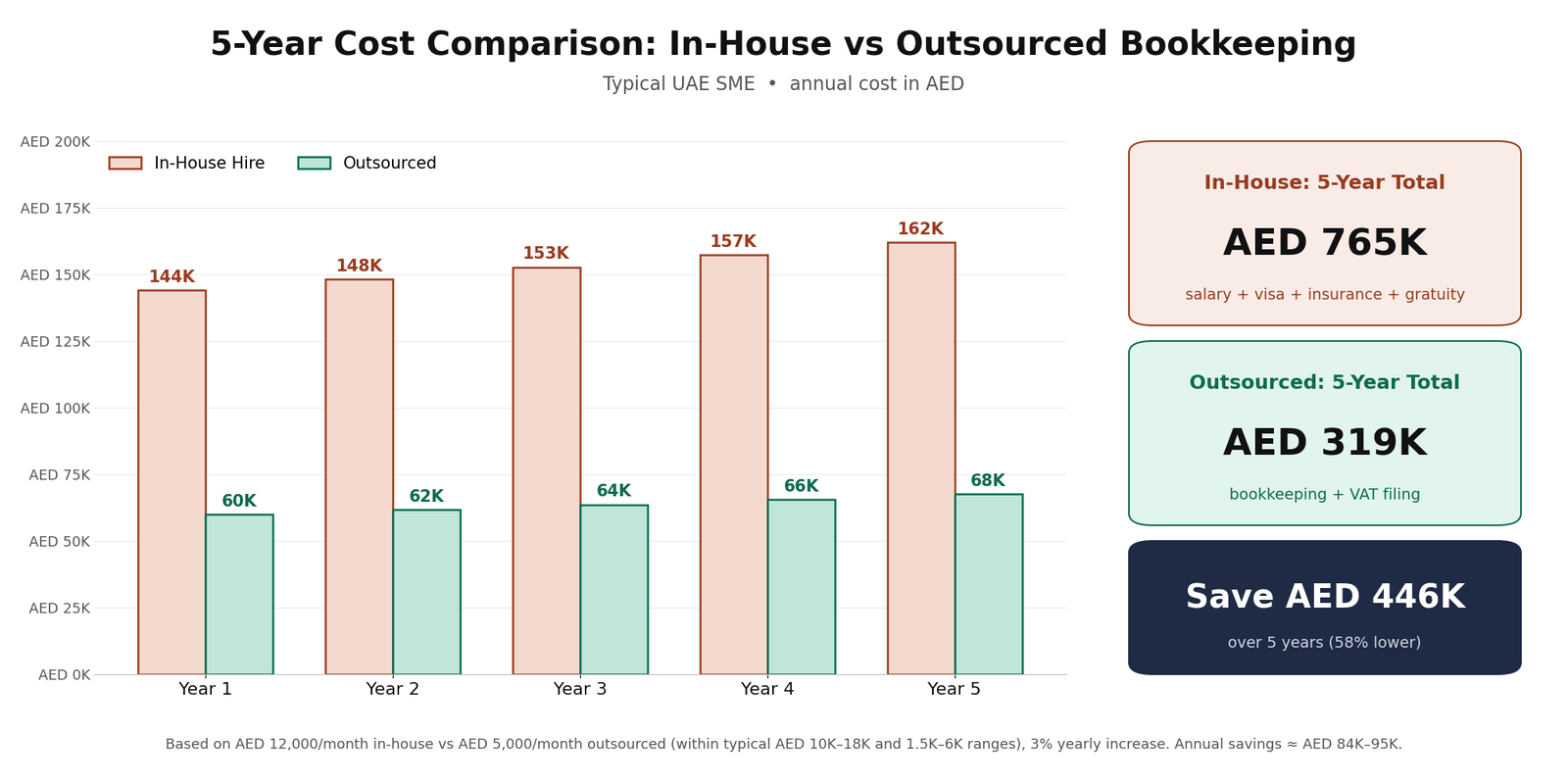
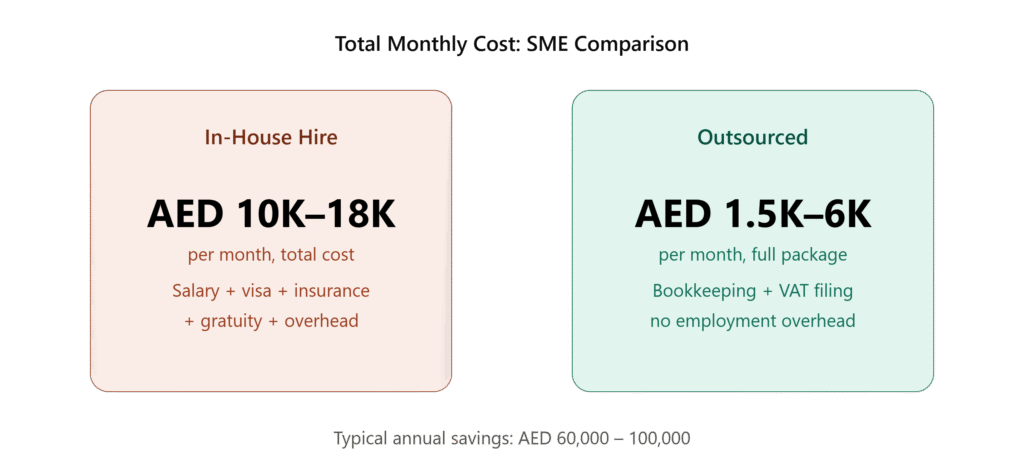
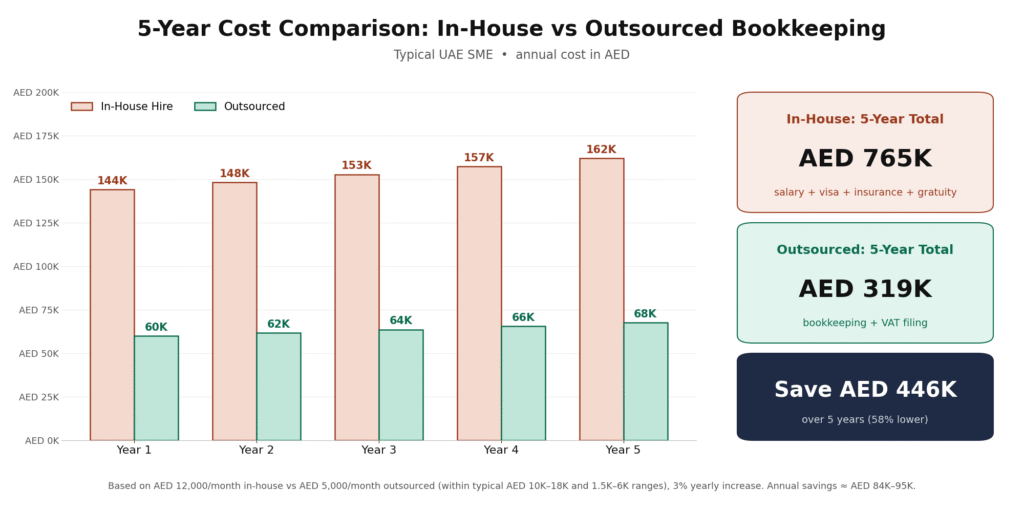
The advertised salary is never the full number. A full-time bookkeeper in the UAE typically earns a base salary of AED 4,000 to AED 12,000 per month, depending on experience and scope of work. A mid-level in-house accountant — someone handling VAT, reconciliations, and management reporting rather than pure data entry — typically costs AED 10,000 to AED 18,000 per month once every employment cost is included, or roughly AED 120,000 to AED 180,000 annually.
That total figure includes items business owners frequently forget to budget for:
- Employment visa and labour card costs
- Health insurance (mandatory in most Emirates)
- End-of-service gratuity accrual
- Recruitment fees or agency costs to find the right hire
- Desk space, a computer, and accounting software licences
- Paid annual leave, with no bookkeeping coverage during that time
- Training time before the hire is fully productive
- The risk of the position sitting vacant during notice periods or resignations
None of this shows up in a job offer letter, but all of it hits the business’s actual monthly cash outflow.
What Outsourced Bookkeeping Actually Costs
Outsourced bookkeeping in the UAE is typically priced by transaction volume and scope rather than by headcount. Based on current 2026 market pricing:
- Micro-businesses and startups (under roughly 50 transactions a month): AED 500 to AED 1,800 per month for basic bookkeeping
- Small to mid-sized businesses (50–100+ transactions a month): AED 1,500 to AED 5,000 per month for bookkeeping plus VAT filing
- Larger or more complex businesses (multiple bank accounts, payroll, multi-currency, Corporate Tax support): AED 5,000 to AED 9,999+ per month for full-service packages
Compare a mid-sized business paying AED 3,000 to AED 6,000 per month for a comprehensive outsourced package against the AED 10,000 to AED 18,000 per month total cost of an equivalent in-house hire, and the annual gap typically lands between AED 60,000 and AED 100,000 — before even accounting for recruitment costs or the productivity lost to a vacant seat.
The Real Comparison: Side by Side
| In-House Bookkeeper/Accountant | Outsourced Bookkeeping | |
|---|---|---|
| Monthly cost (typical SME) | AED 10,000–18,000 total | AED 1,500–6,000 |
| Visa, insurance, gratuity | Employer’s responsibility | Not applicable |
| Coverage during leave/illness | Gap in service | Continuous |
| Access to VAT/CT expertise | Depends on one person’s knowledge | Team-level expertise |
| Scalability | Requires rehiring to scale | Adjusts with your package |
| Software and tools | Employer provides | Usually included |
| Risk if the hire doesn’t work out | Recruitment cycle repeats | Provider is replaced, not rehired |
When In-House Actually Makes Sense
Outsourcing isn’t universally the better answer — it’s the better answer for most SMEs, but not all of them. An in-house hire starts to make sense once a business has high daily transaction volume that needs same-day handling, a finance function complex enough to justify a full-time role beyond bookkeeping (treasury, budgeting, board reporting), or a size where a full internal finance team is the next logical step regardless of pure cost comparison. For most businesses below that scale, the in-house cost premium isn’t buying meaningfully better service — it’s buying a full-time employee for a part-time need.
When Outsourced Bookkeeping Makes More Sense
For the majority of UAE SMEs — retail, trading, professional services, e-commerce, F&B — outsourced bookkeeping wins on more than just price. You get continuous coverage with no gaps during annual leave or resignations, access to a team that already knows FTA rules rather than one person’s individual knowledge, and the ability to scale the service up or down as transaction volume changes, without a hiring or termination process either way.
Hidden Costs Business Owners Often Miss
Beyond salary, three costs quietly inflate the true price of in-house bookkeeping: the recruitment cost of finding and vetting a qualified candidate, the training period before a new hire is fully productive on your specific books, and the coverage gap when your one bookkeeper is on leave, sick, or resigns with a VAT deadline approaching. Outsourced providers absorb all three as part of their standard service, since continuity across staff changes is built into how they operate.
Frequently Asked Questions
Is outsourced bookkeeping actually cheaper than hiring in-house in the UAE?
Yes, in most cases — outsourced bookkeeping typically costs 40% to 80% less than the full cost of an equivalent in-house hire, once visa, insurance, gratuity, and overhead are included in the comparison.
Can outsourced bookkeeping handle VAT filing as well?
Yes. Most outsourced bookkeeping packages for UAE businesses include VAT return preparation and FTA filing as a core part of the service, not an add-on.
What size of business should still consider hiring in-house?
Businesses with high daily transaction volume needing same-day processing, or those building a full internal finance function beyond bookkeeping, are the clearest candidates for an in-house hire.
Can we switch from in-house to outsourced without disruption?
Yes — a reputable provider will review your existing records, reconcile any gaps, and take over from wherever your books currently stand, without requiring a clean calendar-year cutover.