How Much Does Bookkeeping Cost in Oman? (2026 Pricing Guide)
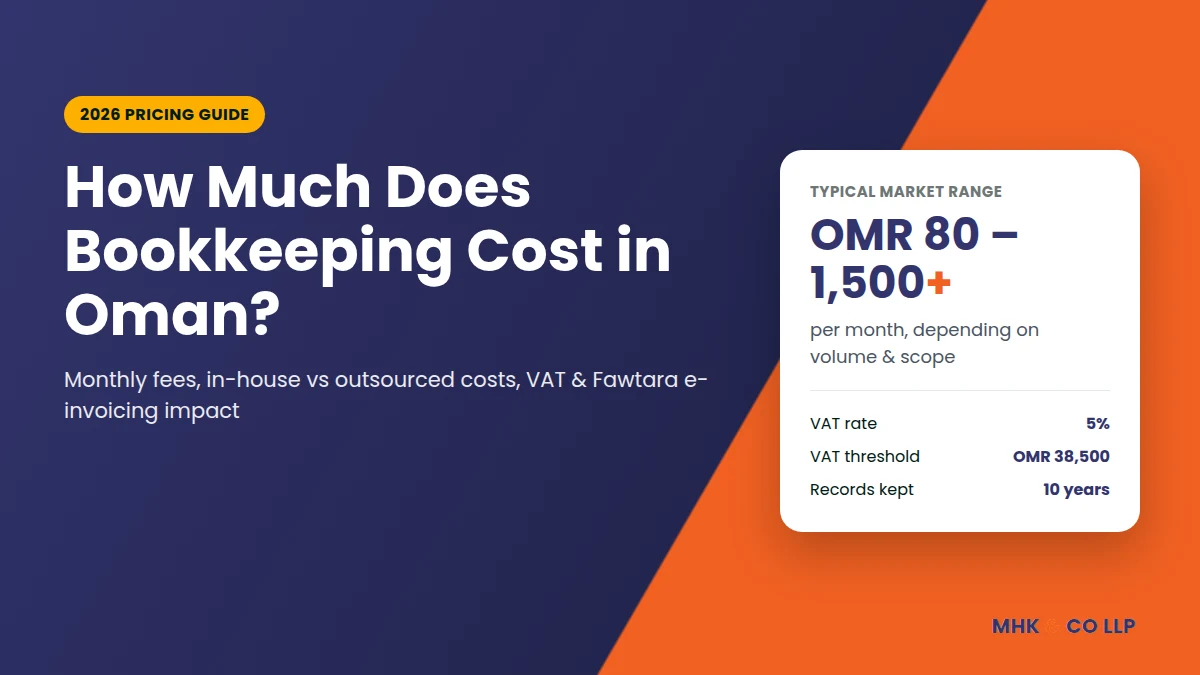
In 2026, outsourced bookkeeping in Oman typically costs OMR 80–150 a month for a startup with very few transactions, OMR 150–350 for a small business, OMR 300–700 for a VAT-registered SME that also needs its VAT return prepared, and OMR 700–1,500+ for large, high-volume or multi-entity businesses. One-time software setup or migration usually adds OMR 200–800. Hiring an in-house accountant instead costs around OMR 483 a month in base salary alone in Muscat, before visa, insurance, gratuity and software.
These figures come from rate cards that Oman accounting firms publish and from current salary data (sources at the end). Your actual fee depends mostly on how many transactions you have, whether you are VAT-registered, and the condition of your existing records.
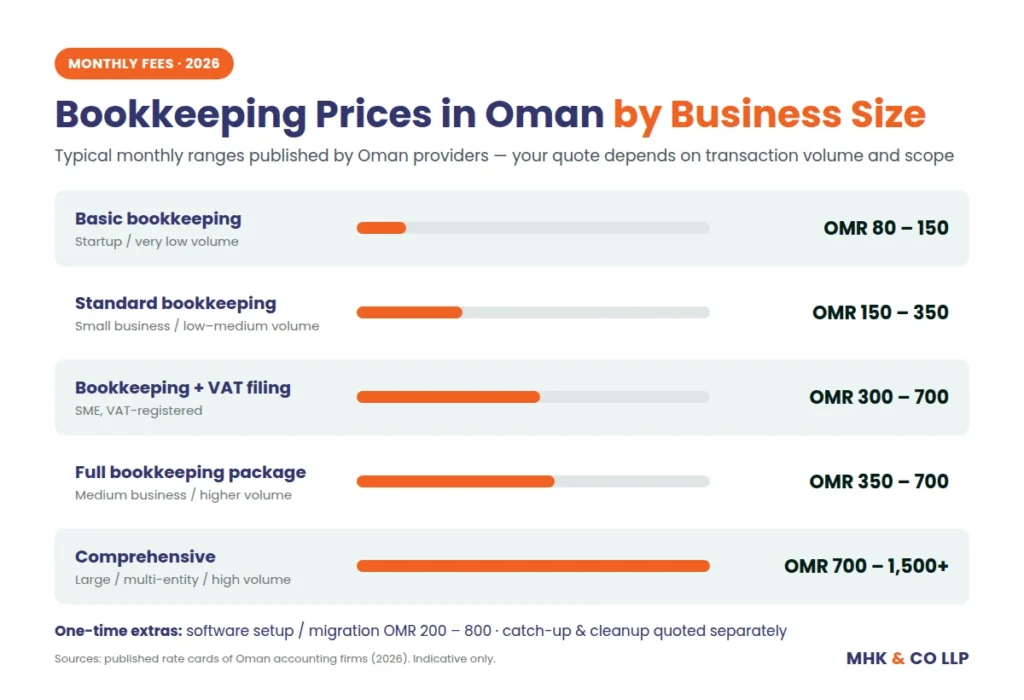
Bookkeeping Prices in Oman by Business Size (2026)
| Package | Typical client | Monthly cost (OMR) | What is usually included |
|---|---|---|---|
| Basic bookkeeping | Startup, freelancer, very low volume | 80 – 150 | Recording sales and expenses, one bank reconciliation, simple monthly summary |
| Standard bookkeeping | Small business, low to medium volume | 150 – 350 | Full ledger, bank and card reconciliations, payables and receivables tracking, monthly P&L and balance sheet |
| Bookkeeping + VAT filing | VAT-registered SME | 300 – 700 | Everything above plus VAT coding, input/output VAT reconciliation and the quarterly OTA return |
| Full bookkeeping package | Medium business, higher volume | 350 – 700 | Inventory, payroll entries, accruals, management reports |
| Comprehensive | Large, multi-entity or multi-currency | 700 – 1,500+ | Consolidation, FX revaluation, detailed management packs, audit support |
| Software setup or migration | One-time | 200 – 800 | Chart of accounts, opening balances, migrating from spreadsheets or another system |
A few patterns hold across almost every Oman provider:
- Most firms quote a fixed monthly fee once they know your volume, rather than billing hourly.
- Annual packages are common. Some providers advertise entry-level bookkeeping from roughly OMR 1,200 a year, while larger engagements can exceed OMR 7,000 a year.
- Catch-up and cleanup work is priced separately. If your books are six months or three years behind, expect a one-off project fee before the monthly retainer starts.
- VAT filing is often an add-on. Always check whether the quoted fee includes preparing and submitting the quarterly VAT return, or only the bookkeeping behind it.
What Drives the Cost of Bookkeeping in Oman?
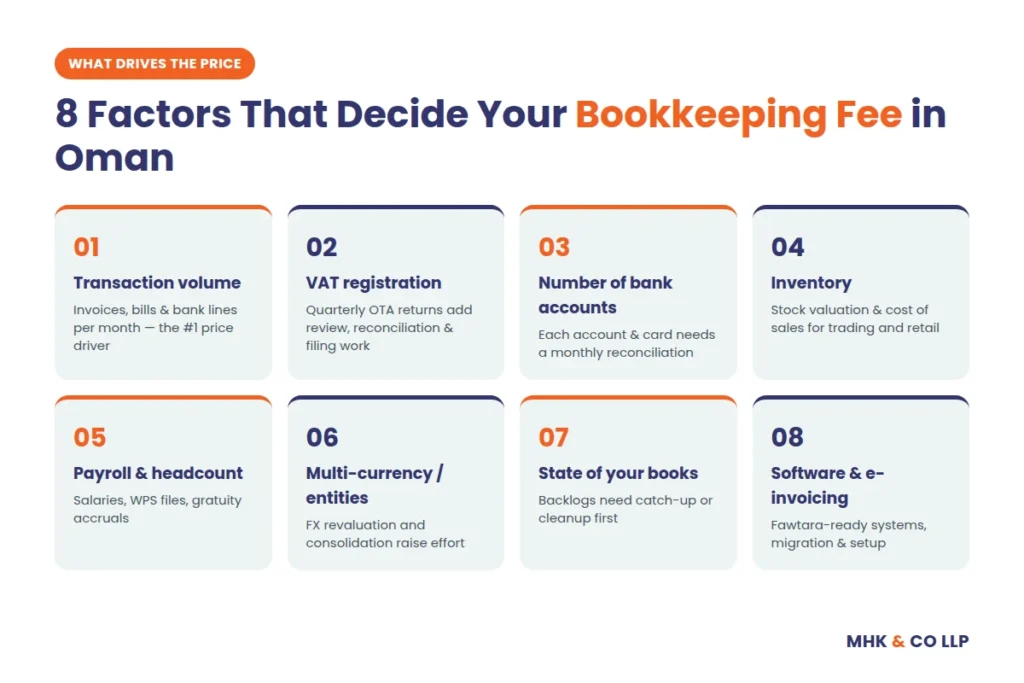
Two businesses with the same revenue can pay very different bookkeeping fees. These are the factors that actually move the price.
1. Transaction volume
This is the biggest driver. A consultancy that raises 15 invoices a month needs far less work than a trading company processing 600 sales invoices, 200 supplier bills and several hundred bank lines. Many firms price in bands, for example up to 100, 400 or 1,000 transactions a month.
2. VAT registration
Oman charges VAT at 5%. Registration is mandatory once your annual taxable supplies exceed OMR 38,500, and voluntary registration is available from OMR 19,250. Once registered, you file a return every quarter, and the return and payment are due within 30 days of the end of the quarter. Each invoice has to be coded correctly (standard-rated, zero-rated, exempt or out of scope), and input VAT has to be supported by valid tax invoices. That extra work is why VAT-registered businesses usually sit in the OMR 300–700 bracket.
3. Number of bank accounts and cards
Every bank account, credit card and payment gateway (card terminals, online payment links, delivery apps) needs its own monthly reconciliation. Three bank accounts and two gateways cost more to reconcile than one current account.
4. Inventory
Trading, retail and F&B businesses need stock movements, cost of sales and inventory valuation recorded correctly. Restaurants add wastage, recipe costing and delivery-platform commissions. We cover this in detail on our page for bookkeeping services for restaurants in Oman.
5. Payroll and headcount
Monthly salary journals, Wage Protection System (WPS) files, leave and end-of-service gratuity accruals all add time, and the effort grows with the number of employees.
6. Multiple currencies or entities
Businesses that buy in USD or AED, or run more than one company, need foreign-exchange revaluation, intercompany reconciliations and sometimes consolidated reports.
7. The state of your existing books
A business with clean, up-to-date records moves straight onto a monthly package. One with missing invoices, unreconciled accounts or a year-end backlog will first need a cleanup project, which is often the single largest cost in the first year.
8. Software and e-invoicing readiness
Your bookkeeper will need a cloud accounting system such as Zoho Books, QuickBooks Online or Xero. From 2027, Oman’s Fawtara e-invoicing mandate also means your invoicing system must produce structured electronic invoices (more on this below). Setup and migration usually cost OMR 200–800 as a one-time fee.
In-House Accountant vs Outsourced Bookkeeping: The Real Cost
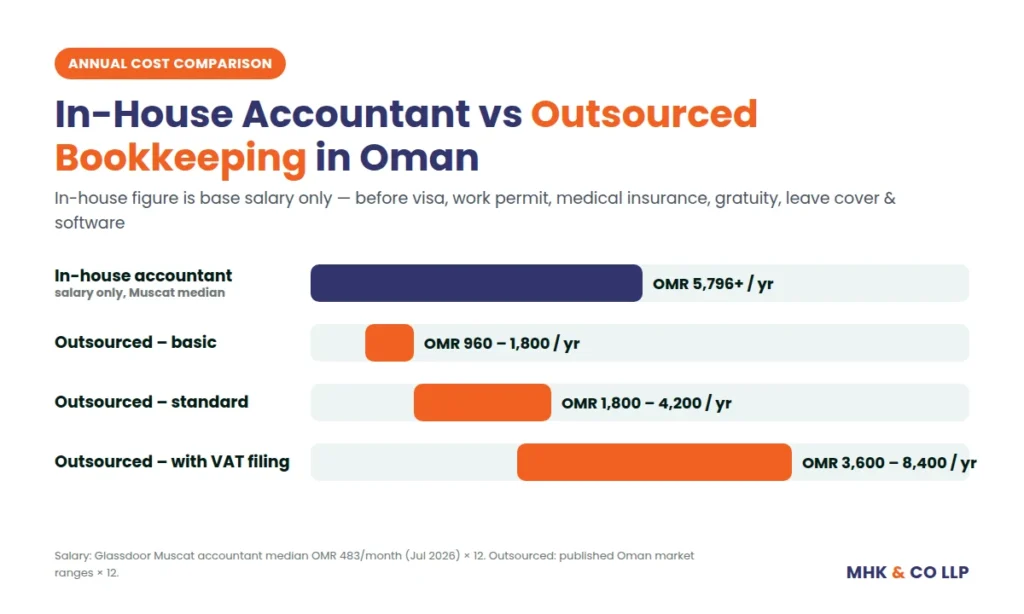
The most common question after “how much does bookkeeping cost?” is whether it would be cheaper to hire someone. Here is what the numbers look like in 2026:
| Cost item | In-house accountant (Muscat) | Outsourced bookkeeping |
|---|---|---|
| Base pay | Around OMR 483/month median (typical range OMR 328–778) | None |
| Annual base cost | Around OMR 5,796 | OMR 960 – 4,200 for basic to standard packages |
| Visa, work permit, medical insurance | Employer pays (expat staff) | Included in the fee |
| End-of-service gratuity and leave | Employer liability | Not applicable |
| Cover during leave or resignation | Your problem | Provider’s team covers it |
| Software licence | Usually extra | Often included or shared |
| VAT and tax knowledge | Depends on one person | A team that files across many clients |
What this means for your decision:
- If you have fewer than a few hundred transactions a month, outsourcing is almost always cheaper. Even a standard package usually costs less than one in-house salary, and that is before any employment costs.
- If you have very high volume, such as a multi-branch retailer, you may eventually need an in-house accounts clerk for daily data entry. Even then, many businesses keep an outsourced firm for monthly review, VAT returns and year-end, because it costs less than hiring a senior accountant.
- A single in-house hire is also a single point of failure. When that person goes on leave or resigns in the middle of a VAT quarter, filings slip, and slipped filings in Oman carry real penalties.
The Hidden Cost: Penalties for Poor Bookkeeping in Oman
A monthly bookkeeping fee is easier to judge when you compare it with the cost of getting compliance wrong. Under Oman’s VAT Law:
| Violation | Penalty |
|---|---|
| Late VAT return | Administrative fine of OMR 500 – 5,000 |
| Late VAT payment | Additional tax of 1% per month (or part of a month) on the unpaid amount |
| Failure to keep proper records and books | Fines of up to OMR 5,000 |
| Incorrect VAT return | Penalty based on the understated tax |
| Tax evasion | Much heavier fines, and possible imprisonment |
VAT records, including invoices, accounting records and customs documents, must be kept for 10 years, or 15 years for real estate.
A single late return can cost more than a full year of basic bookkeeping. Good books don’t only help you avoid fines. They also make your annual audit faster and cheaper, since Oman audit fees commonly run OMR 500–1,500 depending on company size, and they give you reliable figures for bank loans, tenders and investors.
Why Choose MHK & CO LLP for Bookkeeping in Oman
MHK & CO LLP provides remote bookkeeping services to businesses in Oman and across the GCC. Our approach keeps costs predictable:
- Scoped, fixed monthly fees based on your actual transaction volume, with no hourly surprises
- VAT-ready books: every transaction coded correctly, and every quarter reconciled before filing
- Cloud-based records you can access at any time, with monthly reports you can actually read
- Cleanup and catch-up for businesses that have fallen behind
- Multi-country support across Oman, Bahrain, the UAE and Kuwait
Call / WhatsApp: +92 346 5021686
Email :
info.mhkco@gmail.com
Frequently Asked Questions
How much does bookkeeping cost per month in Oman?
Outsourced bookkeeping in Oman typically costs OMR 80–150 a month for startups, OMR 150–350 for small businesses, OMR 300–700 for VAT-registered SMEs that include VAT filing, and OMR 700–1,500+ for large or multi-entity businesses.
Is it cheaper to hire an accountant or outsource bookkeeping in Oman?
For most small and medium businesses, outsourcing is cheaper. The median accountant salary in Muscat is around OMR 483 a month, or about OMR 5,800 a year, before visa, insurance, gratuity and software costs. Most small businesses can outsource their bookkeeping for OMR 1,800–4,200 a year.
Do small businesses in Oman need to keep books?
Yes. Businesses must keep proper accounting records to file their annual income tax return, and VAT-registered businesses must keep invoices and accounting records for 10 years (15 years for real estate). Failing to keep records can lead to fines of up to OMR 5,000.
When must a business register for VAT in Oman?
Registration is mandatory when annual taxable supplies exceed OMR 38,500. Voluntary registration is available from OMR 19,250. VAT is charged at 5%, and returns are filed quarterly within 30 days after each quarter ends.
What is the penalty for filing a VAT return late in Oman?
A late VAT return can attract an administrative penalty of OMR 500–5,000. Late payment adds 1% per month (or part of a month) on the unpaid tax.
Does Oman’s e-invoicing mandate affect my bookkeeping?
Yes. Under Tax Authority Decision No. 189/2026, e-invoicing becomes mandatory on 1 April 2027 for businesses with annual supplies above OMR 5 million, and on 1 October 2027 for all other VAT-registered businesses. You will need an e-invoicing-ready accounting system.
Can a small business in Oman pay 3% corporate tax instead of 15%?
Yes, if it is an Omani sole proprietorship or LLC with registered capital of no more than OMR 60,000, gross income of no more than OMR 150,000, an average of no more than 25 employees, and no activity in excluded sectors. Accurate bookkeeping is needed to show that it qualifies.
How much does it cost to clean up old books in Oman?
Cleanup and catch-up work is usually quoted as a one-time project based on how many months are behind and how many transactions they contain. Software setup or migration typically adds OMR 200–800.
Is bookkeeping cheaper in Oman or Bahrain?
Monthly fees are broadly similar for remote bookkeeping. The compliance scope differs: Bahrain has a 10% VAT rate but no general corporate income tax, while Oman has 5% VAT plus a 15% or 3% corporate income tax, and mandatory e-invoicing from 2027.