
Remote Bookkeeping Services in Kuwait City
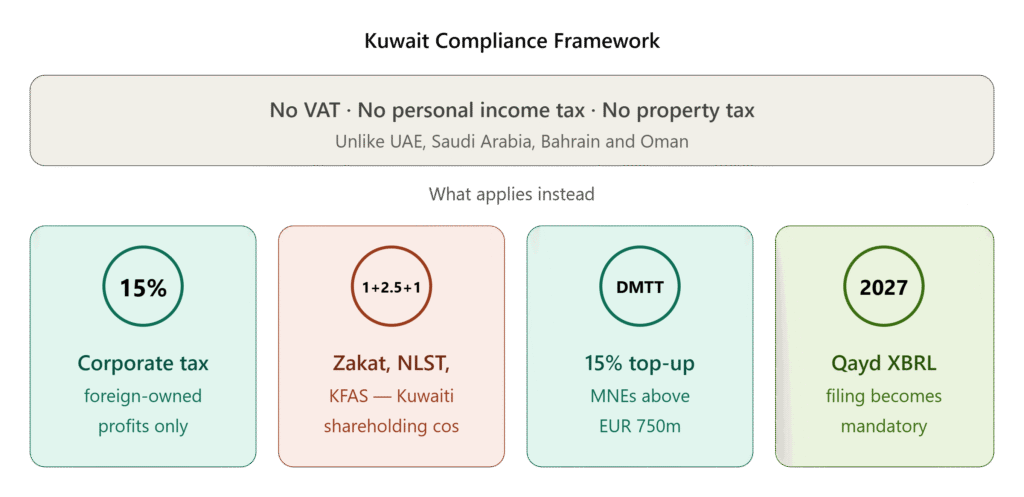
Kuwait City is the country’s financial and administrative center — home to Boursa Kuwait, the major banks and investment houses, government ministries, and the Shuwaikh Industrial Area, one of Kuwait’s oldest and largest commercial and light-industrial zones. Unlike most of the GCC, Kuwait has no VAT, no personal income tax, and no property tax, which makes many business owners assume bookkeeping compliance is simpler here than in Dubai, Riyadh, or Manama. In practice, Kuwait’s requirements are just structured differently — around corporate income tax on foreign-owned entities, Zakat, NLST, KFAS, and the incoming Qayd XBRL filing regime.
MHK & CO LLP provides remote bookkeeping services in Kuwait City built around that actual framework, not a generic GCC VAT template that doesn’t apply here.
Why Kuwait City Businesses Need Kuwait-Specific Bookkeeping
Kuwait’s tax obligations depend heavily on ownership structure in a way that no other GCC market matches. A wholly Kuwaiti or GCC-owned company pays no corporate income tax at all, while a foreign-owned company pays 15% on Kuwait-sourced profits. Kuwaiti shareholding companies carry Zakat at 1%, NLST at 2.5%, and KFAS at 1% on top. That means two businesses operating on the same Kuwait City street, generating identical revenue, can have completely different compliance obligations purely based on who owns them — and bookkeeping that ignores this produces numbers that can’t support either filing.
Common Bookkeeping Problems We Fix for Kuwait City Businesses
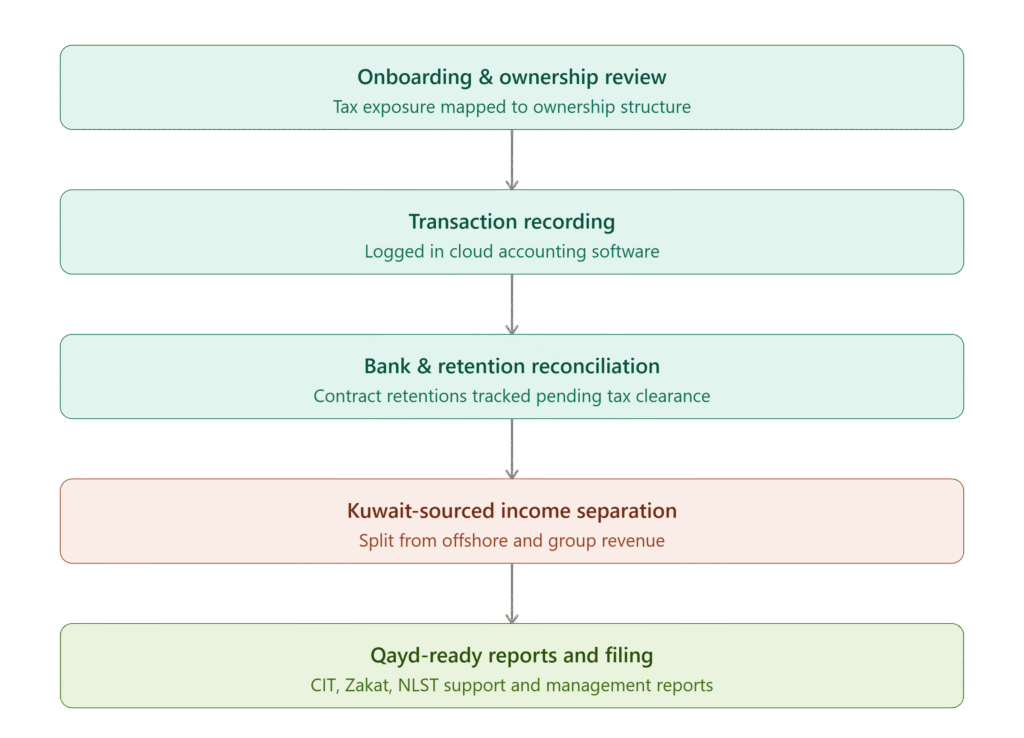
The most frequent issue we see among foreign-owned firms in Kuwait City is Kuwait-sourced income not being clearly separated from group or offshore revenue, which becomes a serious problem when the Kuwait Tax Authority assesses taxable profit — authorities also examine offshore contracts connected to Kuwait activities. The second recurring problem affects foreign contractors and service providers: Kuwaiti payers commonly retain a portion of contract payments until tax clearance is produced, and businesses that haven’t tracked these retentions in their books end up with receivables they can’t reconcile. We structure the chart of accounts so both are visible from the start.
What Our Remote Bookkeeping Service in Kuwait City Includes
- Daily or weekly transaction recording via cloud accounting software
- Bank and payment reconciliation, including multi-currency accounts
- Separation of Kuwait-sourced and non-Kuwait income for corporate income tax purposes
- Contract retention tracking for foreign contractors awaiting tax clearance
- Zakat, NLST, and KFAS computation support for Kuwaiti shareholding companies
- Qayd XBRL-ready financial record structuring ahead of the 2027 mandatory deadline
- Monthly management reports (P&L, balance sheet, cash flow summary)
Corporate Tax and Regulatory Compliance in Kuwait City
Kuwait imposes a flat 15% corporate income tax on foreign-owned company profits, with wholly Kuwaiti and GCC-owned firms generally exempt. Multinational groups with consolidated annual revenue of EUR 750 million or more have been subject to a 15% Domestic Minimum Top-Up Tax since fiscal years beginning 1 January 2025, which replaces the older CIT, Zakat, and NLST combination rather than stacking on top of it. Separately, Kuwait’s Qayd XBRL financial filing system is currently voluntary but becomes mandatory from 1 January 2027 — which means the way records are structured now determines how difficult that transition will be. All companies also maintain their commercial registration with the Ministry of Commerce and Industry.
Industries We Serve in Kuwait City
Our Kuwait City clients include banks, investment houses and financial services firms, trading and import businesses in the Shuwaikh Industrial Area, professional services and consulting firms, contractors working on government and oil-sector projects, and branch offices of regional and international companies — each with bookkeeping structured around their ownership profile and tax exposure.
Why Choose MHK & CO LLP for Remote Bookkeeping in Kuwait City
We build Kuwait bookkeeping around Kuwait’s actual framework — ownership-driven tax exposure, retention mechanics, Zakat and NLST, and the Qayd transition — rather than applying a GCC VAT template that doesn’t apply in this market. If your business also operates in Hawalli, Al Ahmadi, or Farwaniya, or elsewhere in the GCC such as Bahrain or Oman, we consolidate bookkeeping across all your locations under one reporting structure. See our Kuwait overview page for the full picture of our coverage.
FAQs
Does my Kuwait City business need to register for VAT?
No. Kuwait has not implemented VAT — the GCC VAT framework agreement remains under discussion. Your obligations depend on corporate income tax, Zakat, NLST, and KFAS instead, based on ownership structure.
Is my company subject to the 15% corporate income tax?
Generally only if there is foreign ownership. Wholly Kuwaiti and GCC-owned companies are typically exempt, while foreign-owned entities pay 15% on Kuwait-sourced profits.
What is Qayd and do I need to prepare for it now?
Qayd is Kuwait’s XBRL financial filing system, voluntary today and mandatory from 1 January 2027 — structuring your records for it now avoids a rushed conversion later.