UAE VAT Compliance Requirements: The Complete 2026 Guide
VAT has applied in the UAE since 2018, but 2026 has brought the most significant changes to the compliance framework since it launched — a new penalty structure, a mandatory e-invoicing rollout on the horizon, and continued tightening of FTA scrutiny on incorrect filings. This guide covers exactly what UAE businesses need to have in place: who must register, how filing actually works, what records the FTA expects you to keep, and what changed in April 2026 that most businesses haven’t caught up on yet.
Who Needs to Register for VAT
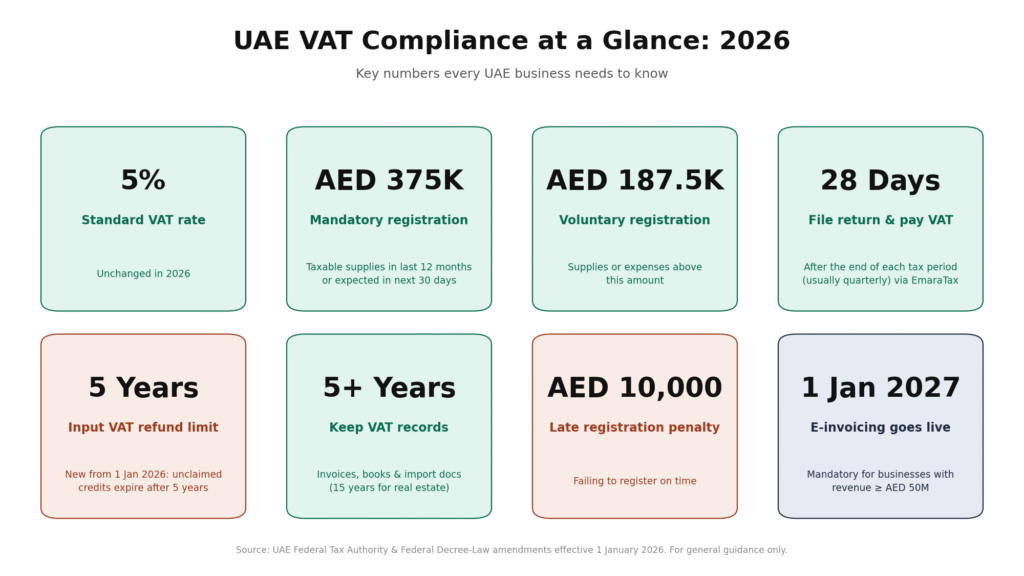
Registration is based on taxable supplies and imports, not company size or industry. A business must register for VAT once its taxable supplies and imports exceed AED 375,000 over the trailing 12 months, or if it expects to exceed that threshold within the next 30 days — whichever comes first. Businesses with taxable supplies between AED 187,500 and AED 375,000 can register voluntarily, which allows them to recover input tax on business expenses even before crossing the mandatory line.
A common misconception is that free zone companies are automatically exempt. They are not. Designated Zones — including JAFZA, KIZAD, DAFZA, and the Fujairah Oil Free Zone — receive specific VAT relief on goods kept under customs control within the zone, but other free zones, including DIFC and ADGM, are treated the same as mainland companies for VAT purposes.
How VAT Registration Works
Registration is completed entirely through the EmaraTax portal. The process involves creating an account, setting up a Taxable Person Profile, completing the VAT registration application with business and financial details, and uploading supporting documents — typically the trade licence, Emirates ID and passport copies of the owners, and proof of turnover. Once submitted, the FTA typically issues a Tax Registration Number (TRN) within 5 to 20 business days. That TRN then needs to appear on every tax invoice, VAT return, and piece of correspondence with the FTA going forward.
Missing the 30-day registration deadline after crossing the mandatory threshold triggers a fixed penalty and can require the business to account for VAT retroactively on all taxable supplies made since the threshold was crossed — which is often a far larger cost than the registration penalty itself.
VAT Filing: Frequency and Deadlines
Once registered, VAT returns must be filed for every assigned tax period — monthly or quarterly, depending on what the FTA assigns based on business size — regardless of whether any taxable activity occurred that period. Returns are due within 28 days of the end of the tax period, filed through EmaraTax. A return still needs to be filed even in a nil period; skipping it because “there was nothing to report” is treated as a late filing.
Invoicing Rules You Need to Get Righ
Tax invoices must meet FTA formatting requirements and be issued within 14 days of the date of supply. Every invoice needs the TRN, a clear breakdown of VAT charged, and the other standard fields the FTA requires — incomplete invoices are one of the more common issues that surface in an FTA review, even when the underlying VAT was calculated correctly.
The Reverse Charge Mechanism
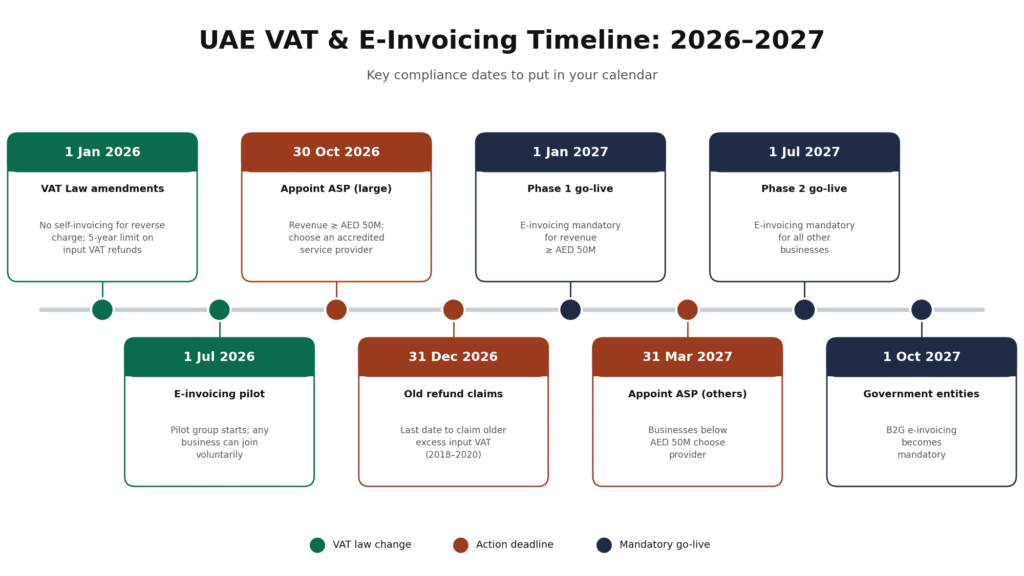
When a UAE business imports services from a foreign supplier that isn’t VAT-registered in the UAE, the obligation to account for VAT shifts to the buyer under the reverse charge mechanism — both output and input VAT need to be declared on the same transaction. From 1 January 2026, the requirement to issue a self-invoice for standard reverse charge imports was removed, which simplified the paperwork, but the underlying obligation to declare the VAT itself has not changed. Businesses that import services regularly — software subscriptions, consulting, offshore contractors — are the ones most likely to miss this.
What Changed in April 2026: The New Penalty Structure
Cabinet Decision No. 129 of 2025, effective from 14 April 2026, replaced the UAE’s long-standing compounding penalty model for late VAT payment. Under the previous system, late payment penalties compounded quickly — 2% immediately, 4% after seven days, then 1% daily, up to a cap of 300% of the unpaid tax. Under the new system, late payment is instead charged at a flat 14% per annum, calculated monthly, which brings VAT penalties in line with the Corporate Tax penalty structure. This is a meaningfully different — and generally less punishing — model than before, but it does not reduce the importance of paying on time; it simply changes how the cost accumulates if you don’t.
Alongside this, other VAT penalties remain in place: a fixed penalty for late registration, and penalties for late filing and incorrect returns that increase for repeat offences within a 24-month window.
Record-Keeping Requirements
The FTA requires VAT-registered businesses to keep full records of sales, purchases, tax invoices, and import/export documentation for 5 years after the tax period they relate to. Records connected to real estate are held to a longer standard — 15 years — reflecting how long real estate transactions can remain relevant to a VAT position. These aren’t passive filing-cabinet requirements: in an FTA review, the burden is on the business to produce supporting documentation for any figure on a filed return, not on the FTA to disprove it.
E-Invoicing: What’s Coming and When
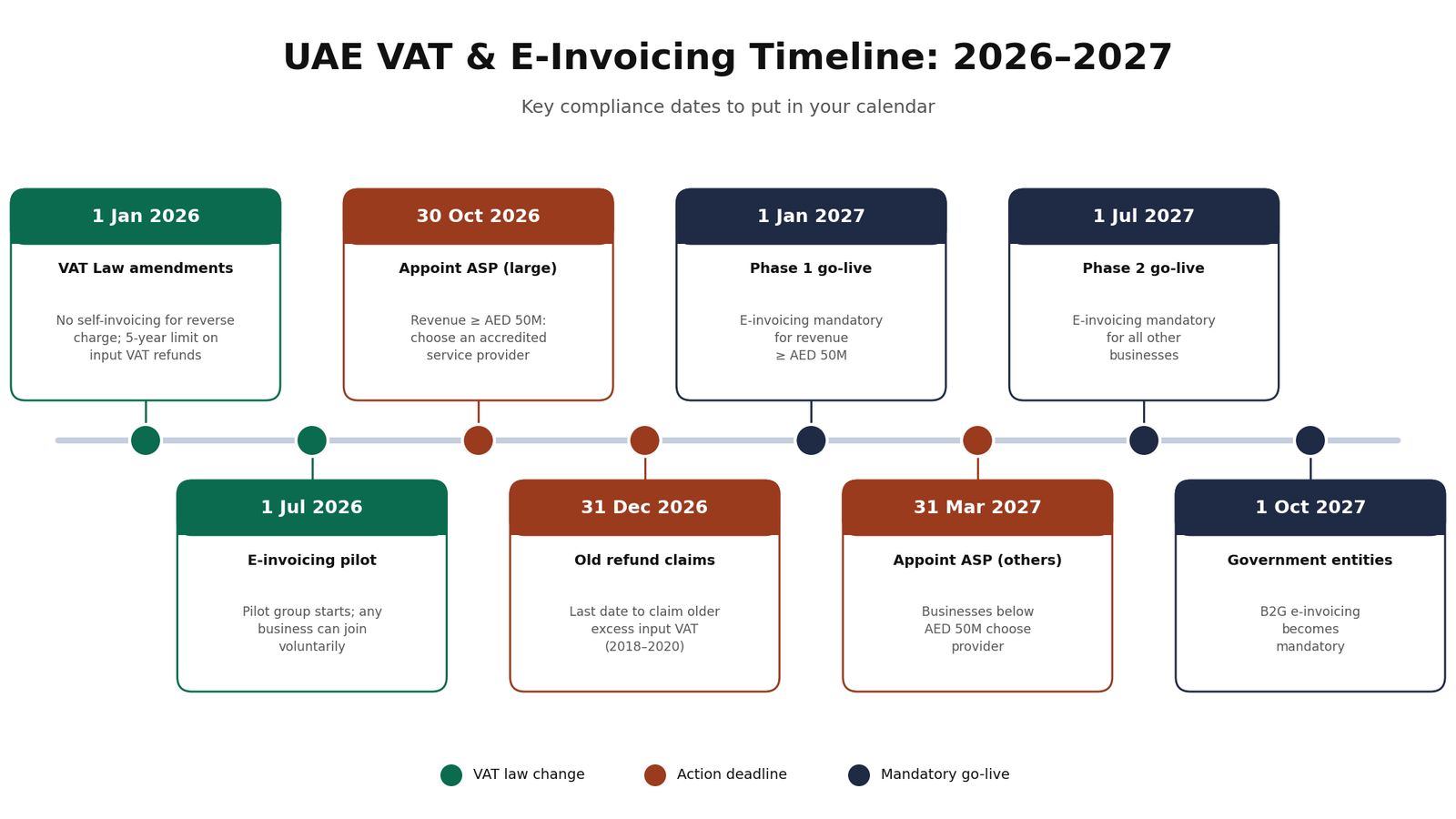
The UAE is moving toward mandatory electronic invoicing under a phased rollout. A voluntary pilot opens on 1 July 2026, and mandatory e-invoicing begins on 1 January 2027 for businesses with annual revenue of AED 50 million or more, with wider phases expected to follow. B2C invoicing remains outside scope for now, pending further FTA guidance. Businesses approaching that revenue threshold should start reviewing their invoicing systems and data now — e-invoicing readiness is not a project that can be completed in the weeks before a mandatory deadline.
Common VAT Compliance Mistakes We See
The most frequent issue is businesses tracking turnover only against annual totals instead of the rolling 12-month window the FTA actually uses, which means they cross the mandatory threshold weeks or months before they notice. The second is treating a nil-activity period as not requiring a return — it still does. The third is under-declaring reverse charge VAT on imported services, particularly software subscriptions and offshore consulting, where no local invoice ever prompts the business to think about VAT at all.
Frequently Asked Questions
What is the VAT registration threshold in the UAE?
AED 375,000 in taxable supplies and imports over a rolling 12-month period makes registration mandatory; AED 187,500 makes it optional.
How long do I need to keep VAT records?
Five years for standard VAT records, and 15 years for records connected to real estate transactions.
Did VAT penalties change in 2026?
Yes. From 14 April 2026, late payment penalties changed from a compounding model (up to 300% of unpaid tax) to a flat 14% per annum charge, under Cabinet Decision No. 129 of 2025.
Are free zone companies exempt from VAT?
Not automatically. Only Designated Zones such as JAFZA, KIZAD, and DAFZA get specific relief on goods under customs control; other free zones, including DIFC and ADGM, follow standard mainland VAT rules.
When does mandatory e-invoicing start in the UAE?
A voluntary pilot begins 1 July 2026, with mandatory e-invoicing starting 1 January 2027 for businesses with annual revenue of AED 50 million or more.